Bakhour : guide complet — histoire, types, utilisation et différence avec l'encens
Bakhour : guide complet — histoire, types, utilisation et différence avec l'encens
Le bakhour est un encens oriental artisanal à base de bois, résines et huiles naturelles, issu de la tradition omanaise. Le marché mondial de l'encens dépasse 12,7 milliards USD en 2024.
Le marché mondial de l'encens a été estimé à 12,73 milliards de dollars en 2024, avec une croissance annuelle projetée de 6,1 % jusqu'en 2033. Au cœur de cet engouement, le bakhour occupe une place singulière : ni simple bâtonnet, ni résine brute, c'est un mélange artisanal de bois précieux, d'huiles parfumées et de résines naturelles, hérité de la tradition arabe.
Le bakhour (بخور en arabe, aussi orthographié bakhoor ou bukhoor) est bien plus qu'un simple parfum d'ambiance. C'est un art de vivre millénaire, ancré dans les traditions du Moyen-Orient, qui transforme chaque espace en un lieu de sérénité et de raffinement. Composé de copeaux de bois imprégnés d'huiles parfumées, de résines précieuses et d'ingrédients naturels, le bakhour libère, une fois brûlée, une fumée riche et enveloppante qui parfume durablement les intérieurs et les vêtements.
Pourtant, malgré sa popularité croissante en Europe et en France, le bakhour reste méconnu. Qu'est-ce qui le distingue de l'encens classique ? Comment brûler correctement ? Quels types choisir ? Ce guide fait le point sur tout ce qu'il faut savoir, des routes caravanières de l'Antiquité à votre salon.
Temps de lecture : 15 minutes
Qu'est-ce que le bakhour exactement ?
Le mot « bakhour » vient de l'arabe بخور (boukhour), qui signifie littéralement « fumée parfumée » ou « encens ». Il désigne un mélange de copeaux de bois parfumés , généralement imprégnés d'huiles essentielles et combinés à des ingrédients naturels tels que des résines, des épices, du musc, de l'ambre ou du bois de santal.
Contrairement à l'encens en bâtonnet que l'on connaît en Occident, le bakhour se présente sous des formes variées : copeaux, blocs compacts, tablettes sécables (en forme de « chocolat »), poudre, billes ou pâte. Une fois brûlée sur un charbon ardent ou dans un brûleur électrique, il libère une fumée dense, aromatique et durable.
Les ingrédients du bakhour
La richesse du bakhour vient de la diversité de ses composants. Voici les ingrédients que l'on retrouve le plus souvent dans les compositions artisanales :
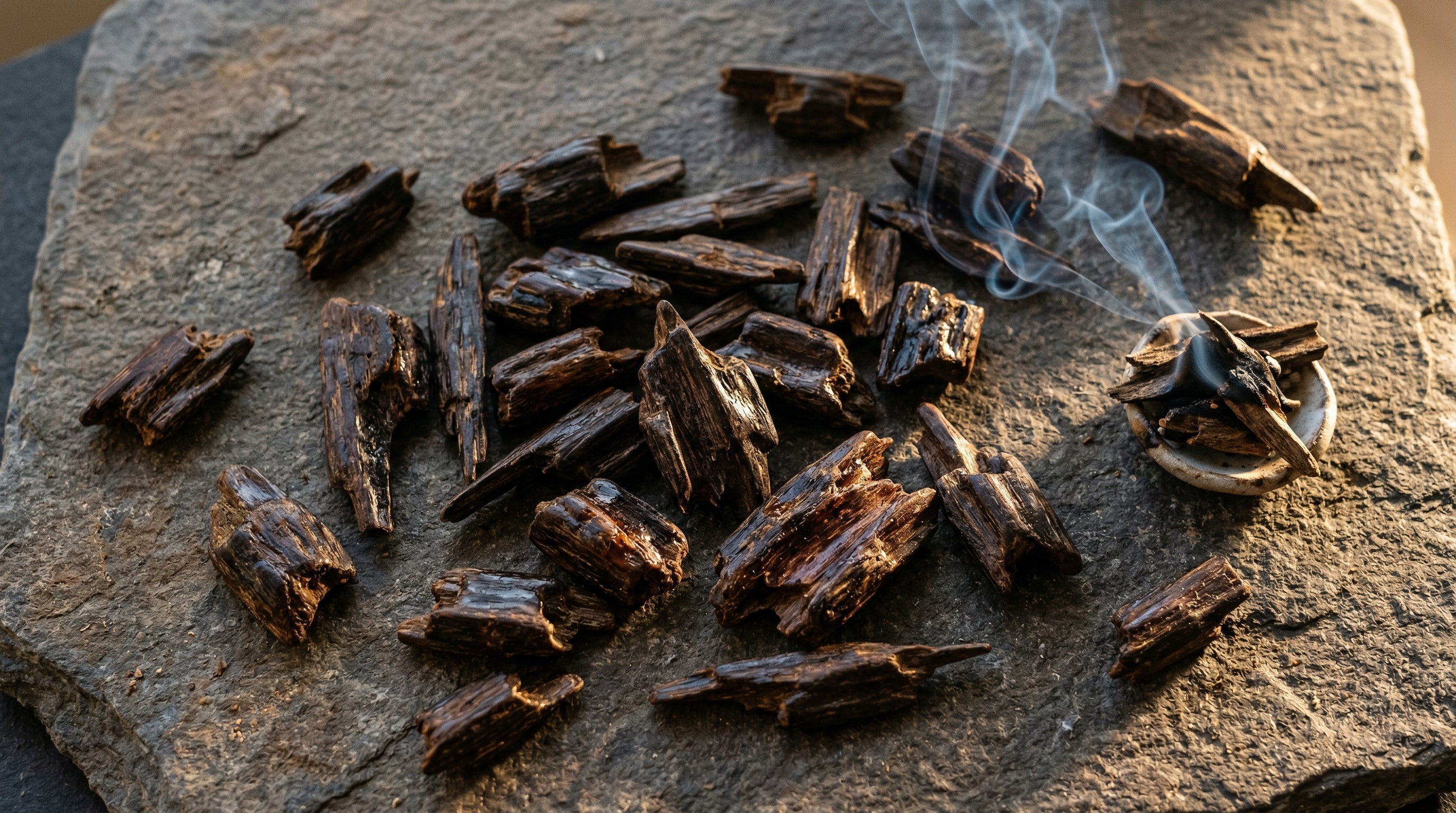
• Bois d'oud (agar) — L'ingrédient roi. Extrait de l'arbre Aquilaria, c'est l'un des bois les plus précieux au monde, pris pour son parfum profond et complexe.
• Bois de santal — Apporte douceur, chaleur et une note crémeuse caractéristique.
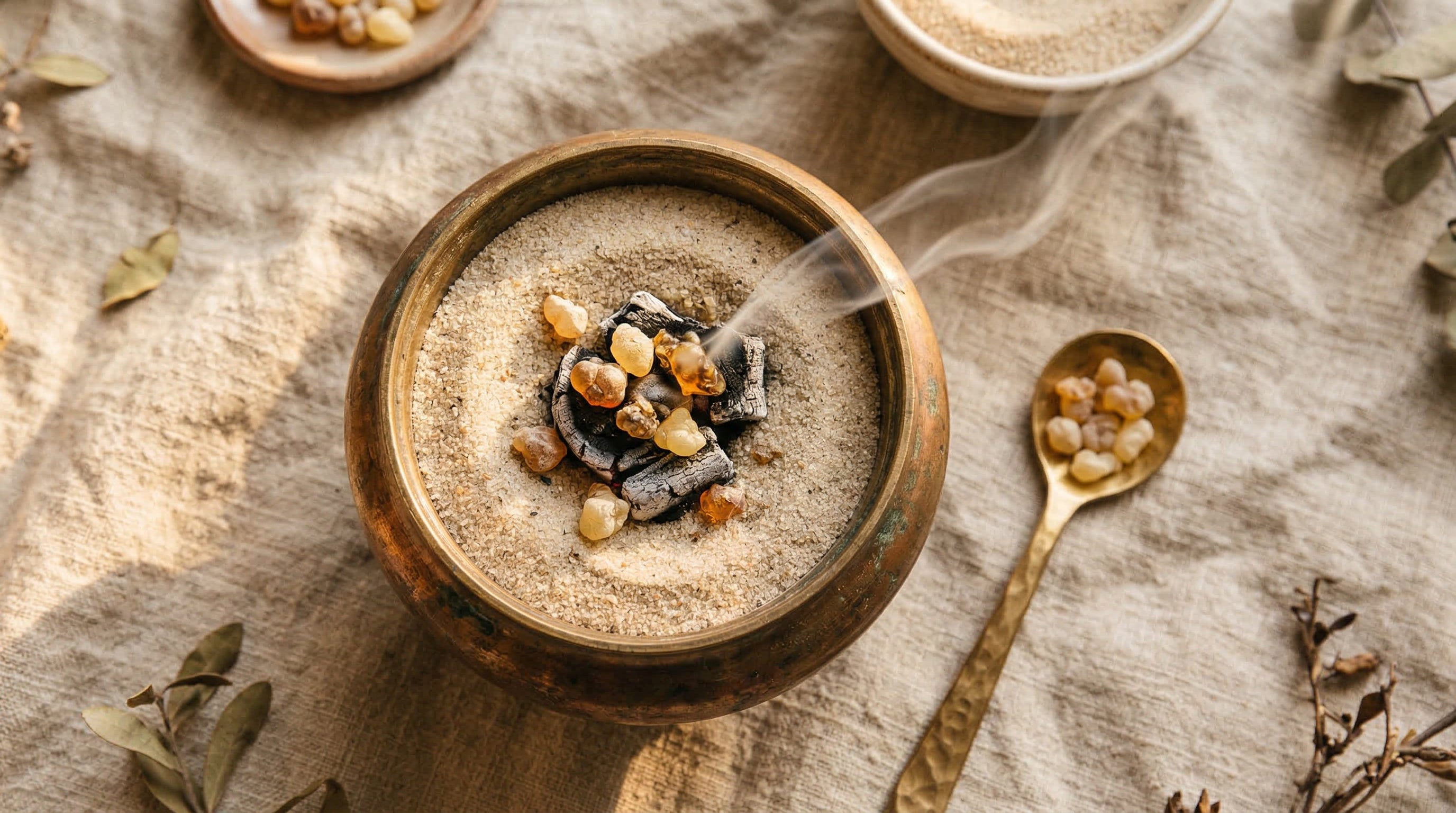
• Résine d'oliban (encens) — Ajoute une dimension spirituelle et purifiante.
• Musc — Confère profondeur et sensualité aux compositions.
• Ambre gris — Note chaude et enveloppante, souvent utilisée en note de fond.
• Huiles essentielles florales — Rose, jasmin, fleur d'oranger pour les compositions plus légères.
• Épices — Cannelle, cardamome, safran pour les bakhours plus chauds et épicés.
• Bois d'aloès — Apporte complexité et une touche boisée raffinée.
Le bois d'oud est l'ingrédient central du bakhour. Pour mieux comprendre sa nature, son origine et ses différentes qualités, consultez notre guide complet sur l'encens oud.
L'histoire du bakhour : des routes caravanières à nos intérieurs
Antiquités d'origine
L'usage du bakhour remonte à l'Antiquité. Dans la péninsule arabique, la fumigation des bois parfumés faisait partie intégrante de la vie quotidienne bien avant l'avènement de l'Islam. Les routes de l'encens, qui reliaient le sud de l'Arabie (actuel Yémen et Oman) à la Méditerranée, transportaient déjà des résines, des bois aromatiques et des parfums vers l'Égypte, la Grèce et Rome.
Le commerce des matières aromatiques était si lucratif que les Romains appelaient le sud de l'Arabie « Arabia Felix » (l'Arabie heureuse), en référence à la richesse générée par ce négoce. Le bakhour était alors un signe de prestige, offert aux rois et brûlé dans les temples.
Le bakhour dans la tradition arabe et islamique
Avec l'avènement de l'Islam, le bakhour a acquis une dimension spirituelle supplémentaire. La fumigation est devenue un geste d'hospitalité fondamental dans la culture arabe : accueillir un invité en lui présentant le bakhour dans un mabkhara (encensoir traditionnel) est un signe de respect et de générosité.
Aujourd'hui encore, le bakhour est incontournable dans les pays du Golfe. Il est brûlé à la maison au quotidien, lors des mariages, des fêtes religieuses (Aïd, Ramadan), des réceptions et même dans les bureaux et les commerces. Dans la tradition arabe, on fait passer l'encensoir de main en main pour que chaque invité puisse s'embaumer de la fumée parfumée.
L'essor du bakhour en occident
Popularisé en France et en Europe depuis une quinzaine d'années, notamment par les pèlerins de retour d'Arabie Saoudite, le bakhour connaît un succès grandiose. Son mode de diffusion, plus intense et durable que les bâtonnets d'encens, séduit de plus en plus d'amateurs de parfums d'intérieur à la recherche d'authenticité et de profondeur olfactive.
Bakhour vs encens : quelles différences ?
C'est la question la plus fréquente, et la confusion est compréhensible. Voici un tableau comparatif détaillé pour tout comprendre :
|
Critère |
Encens classique |
Bakhour |
|
Définition |
Résine naturelle ou bâtonnet de pâte végétale |
Copeaux de bois imprégnés d'huiles parfumées + résines |
|
Pour moi |
Bâtonnets, cônes, grains de résine |
Copeaux, blocs, comprimés, poudre, pâte |
|
Composition |
Résine pure (oliban, myrrhe) ou mélange simple |
Bois d'oud, santal, musc, ambre, huiles, épices |
|
Intensité |
Légère à modérée |
Forte à très forte — remplit une pièce |
|
Durée |
30 min à 1 h (bâtonnet) |
Plusieurs heures, imprègne les tissus |
|
Combustion |
Auto-combustion (s'allume directement) |
Nécessite un charbon ou un brûleur électrique |
|
Origine culturelle |
Universel (Asie, Afrique, Europe) |
Péninsule arabique et Moyen-Orient |
|
Prix |
Économique |
Modéré à élevé (selon le bois d'oud) |
|
Principe d'utilisation |
Méditation, spiritualité, ambiance légère |
Parfumer intensément la maison, les vêtements, l'hospitalité |
En résumé, le bakhour est une forme d'encens, mais tout encens n'est pas du bakhour . Le bakhour se distingue par sa composition riche (bois d'oud, huiles parfumées), son intensité olfactive supérieure et son ancrage dans la culture arabe. L'encens classique (oliban, myrrhe, bâtonnets) est plus universel et généralement plus léger.
Les différents types de bakhour
Par ingrédient principal
• Bakhour au oud (bois d'agar) — Le plus prestigieux. Les copeaux de bois d'agar sont imprégnés d'huiles de oud. Parfum profond, boisé, animal et enveloppant. C'est le bakhour de référence dans les pays du Golfe.
• Bakhour au santal — Plus doux et crémeux. Idéal pour la relaxation et la méditation. Notes chaudes et apaisantes.
• Bakhour au musc — Sensuel et persistant. Souvent utilisé lors des mariages et des occasions spéciales.
• Bakhour à l'ambre — Chaleureux et enveloppant. Parfait pour créer une atmosphère cosy en hiver.
• Bakhour floral — À base de rose, de jasmin ou de fleur d'oranger. Plus léger, adapté au quotidien et aux espaces de vie.
• Bakhour épicé — Cannelle, cardamome, safran. Stimulant et dynamisant, idéal pour les espaces de réception.
Par forme
• Copeaux (copeaux) — La forme la plus traditionnelle. Morceaux de bois imprégnés.
• Tablettes (chocolat) — Blocs sécables pratiques à doser. Très populaires en France.
• Poudre (mabthooth) — Bois finement broyé, souvent mélangé à du oud en poudre. S'utiliser sur brûleur électrique.
• Pâte / billes — Compositions compactes et concentrées. Longue durée de combustion.
• Mamool — Mélange préparé à base de bois et de résines agglomérées, souvent de forme cylindrique.
Par origine
• Bakhour omanais — Réputé pour sa finesse et sa complexité. Oman est le berceau historique du commerce de l'encens. C'est ce savoir-faire que Real & Roots a choisi de vous proposer avec sa collection infusée artisanalement.
• Bakhour émirati — Souvent plus opulent et sucré. Les Émirats sont le plus grand marché mondial de bakhour.
• Bakhour saoudien — Intense et généreux. Très utilisé lors des grandes occasions religieuses.
• Bakhour yéménite — Artisanal et brut. Traditions de fabrication ancestrales.
• Bakhour indien — Bâtonnets de bakhoor roulés à la main (Asli Bakhoor), souvent à base d'herbes et de résines indiennes.
Comment brûler et utiliser le bakhour : guide pas à pas
Méthode 1 : Sur charbon ardent (traditionnelle)
C'est la méthode ancestrale, celle qui offre le rendu olfactif le plus intense et le plus authentique.
Ce qu'il vous faut :
• Un encensoir (mabkhara) ou tout récipient résistant à la chaleur
• Des pastilles de charbon auto-allumantes
• Un briquet ou allumettes
• Une pince métallique
• Votre bakhour
Étapes :
1. Allumez la pastille de charbon avec une briquet, en la tenant avec la pince. Attention aux projections.
2. Attendez que le charbon devienne entièrement incandescent (couvert d'une fine couche de cendre grise). Cela prend environ 2 à 3 minutes.
3. Placez le charbon dans l'encensoir sur une surface non inflammable.
4. Déposez délicatement quelques copeaux ou un morceau de bakhour sur le charbon.
5. Laissez la fumée parfumée se diffuser. Vous pouvez déplacer l'encensoir de pièce en pièce ou le faire passer pour embaumer les vêtements.
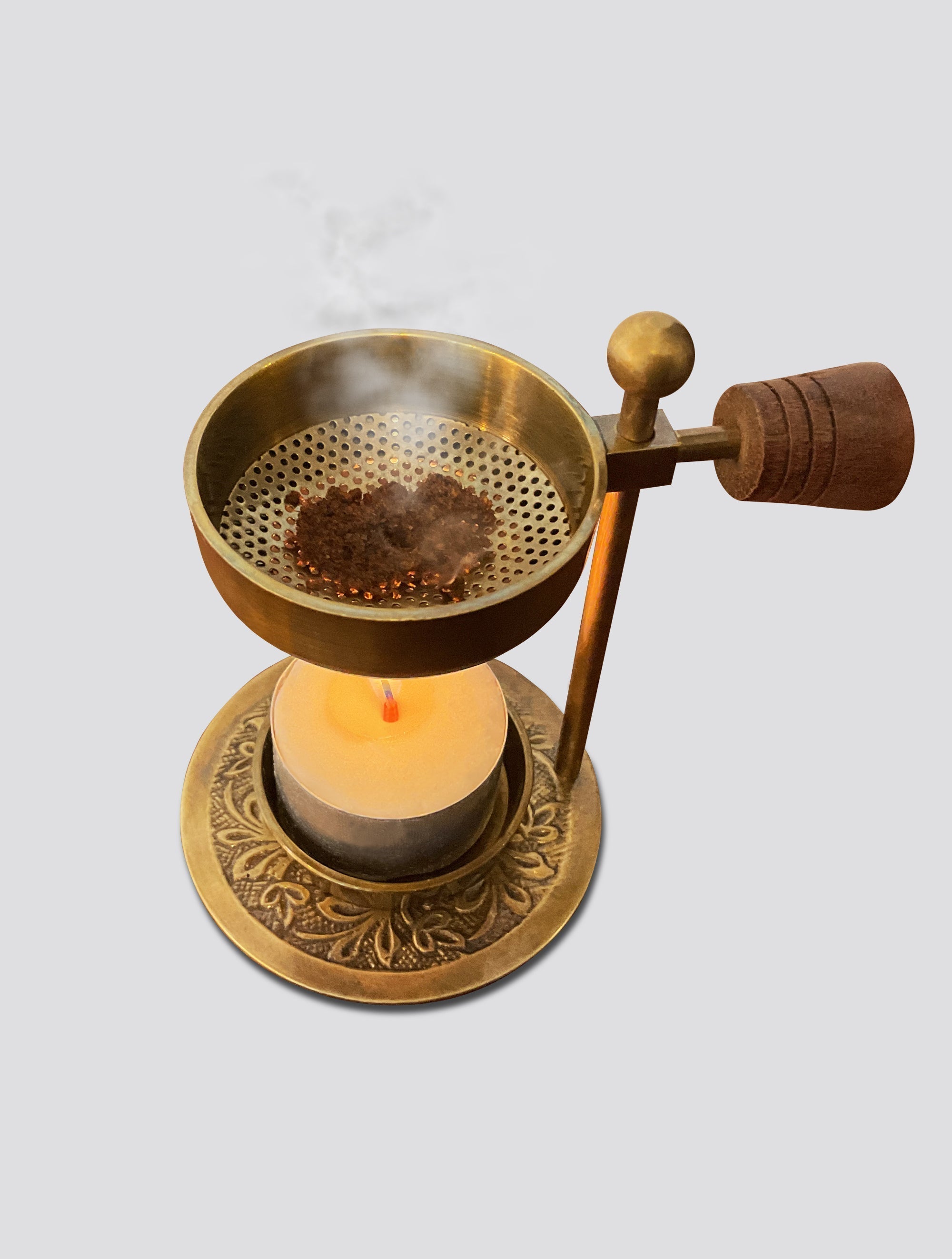
Méthode 2 : Avec un brûleur électrique (moderne)
Plus pratique et plus sûr, le brûleur électrique chauffe le bakhour sans flamme ni charbon. Il suffit de brancher le brûleur, de déposer le bakhour sur le plateau (idéalement sur un morceau d'aluminium pour faciliter le nettoyage) et de laisser la chaleur libérer les arômes progressivement.
Cette méthode offre une diffusion plus douce et plus longue. Elle est idéale pour un usage quotidien et dans les espaces où la flamme n'est pas souhaitée (chambre, bureau).
Conseils d'utilisation
• Dosage — Une cuillère à café de poudre ou 2-3 petits copeaux suffisent pour une pièce standard. Le bakhour est très concentré : mieux vaut commencer léger.
• Ventilation — Assurez-vous que la pièce est correctement aérée. La fumée est aromatique mais dense.
• Sécurité — Gardez l'encensoir hors de portée des enfants et des animaux. Ne laissez jamais un charbon sans surveillance.
• Parfumer les vêtements — Suspendez vos vêtements au-dessus de la fumée pendant quelques minutes. Le parfum tient plusieurs jours.
• Conservation — Conservez votre bakhour dans un endroit frais et sec, à l'abri de la lumière, dans un contenant hermétique pour préserver ses arômes. Pour aller plus loin sur les techniques de combustion et les accessoires, notre guide pratique sur comment brûler l'encens et le bakhour détaille chaque étape.
Les bienfaits du bakhour
Si le bakhour est un plaisir olfactif ses composants naturels lui confèrent également de véritables vertus pour le bien-être.
Purification de l'air
Le bakhour est reconnu pour ses propriétés antibactériennes . Utilisé depuis des siècles en Asie et au Moyen-Orient, il aide à neutraliser les agents pathogènes présents dans l'air et à maintenir un environnement intérieur plus sain. Notamment grâce à la résine d'oliban qu'il contient souvent, connue pour ses vertus antiseptiques et antivirales.
Détente et lutte contre le stress
La ritualisation même de la préparation et de la fumigation du bakhour invite à la méditation et au lâcher-prise . Les senteurs boisées et ambrées fournissent à ancrer l'esprit et à réduire l'anxiété. C'est un outil naturel de gestion du stress, utilisé depuis des millénaires.
Aide au sommeil
Certaines variétés de bakhour, notamment celles contenant de la cannelle ou du santal , sont particulièrement efficaces pour favoriser l'endormissement. Brûler un peu de bakhour 30 minutes avant le coucher peut aider à créer une atmosphère propice au repos.
Concentration et créativité
Les notes plus dynamiques (agrumes, épices) peuvent stimuler la concentration et la créativité. Dans la tradition arabe, le bakhour est souvent brûlé dans les espaces de travail pour maintenir un esprit vif et alerte.
Hospitalité et convivialité
Au-delà de ses bienfaits physiques, le bakhour crée un lien social. Offrir l'encens à ses invités est un geste d'accueil universel dans la culture arabe, qui transforme chaque visite en un moment de partage et de respect mutuel.
La collection bakhour réel et racines : l'artisanat omanais
Chez Real et Roots, nous avons fait le choix de l'authenticité. Notre collection de bakhour provient d'Oman, berceau historique du commerce de l'encens et terre de traditions olfactives millénaires. Chaque composition est infusée artisanalement par nos partenaires omanais, selon un savoir-faire transmis de génération en génération.
Bakhour essence de majlis
Notre signature bakhour, conçue pour apporter sérénité et équilibre . Ses notes de tête de musc, son cœur de bois de oud et sa base d'ambre gris en font un compagnon idéal pour les moments de calme et de contemplation. Le Majlis (salon de réception arabe) est le lieu par excellence de l'hospitalité : ce bakhour en capture l'essence.
Échos de Bakhour
Inspiré par l'héritage du bakhour, Echoes capture des souvenirs intemporels dans son parfum. Des notes profondes de grenade et de cassis lui confèrent une personnalité unique et contemporaine, tout en respectant les codes de la tradition.
Bakhour éclats de citrus
Pour ceux qui préfèrent la fraîcheur, nos Éclats de Citrus célèbres des notes vives de citron et d'orange , adoucies par des figues sucrées et des dattes en cœur. Un bakhour lumineux, parfait pour le quotidien et les espaces de vie.
Questions fréquentes sur le bakhour
Quelle est la différence entre bakhour, bakhoor et bukhoor ?
Ce sont trois orthographes différentes du même mot arabe بخور. En France, on utilise le plus souvent « bakhour » ou « bakhoor ». Il n'y a aucune différence de produit : il s'agit dans tous les cas d'encens oriental à base de bois parfumés.
Le bakhour est-il dangereux pour la santé ?
Utilisé avec modération et dans un espace correctement ventilé, le bakhour n'est pas dangereux. Comme pour tout encens, il est déconseillé de brûler du bakhour dans une pièce fermée sans aération, et de l'utiliser en présence de personnes souffrant d'asthme ou de troubles respiratoires sévères. Privilégiez les bakhours à base d'ingrédients naturels.
Quelle est la différence entre le bakhour et le oud ?
Le oud (ou agarwood) désigne spécifiquement les copeaux bruts de bois d'agar, un matériau naturel très précieux et peu transformé. Le bakhour est un produit composé qui contient souvent du oud, mais aussi d'autres ingrédients (santal, musc, huiles, résines). Le oud est une matière première ; le bakhour est une composition parfumée.
Comment choisir un bon bakhour ?
Privilégiez les bakhours à base d'ingrédients naturels, provenant de fabricants artisanaux identifiés (Oman, Yémen, Émirats). Méfiez-vous des bakhours très bon marché qui contiennent souvent des composés synthétiques. Un bon bakhour doit avoir une odeur agréable même non brûlée, et ses copeaux doivent être légèrement huileux au toucher.
Combien de temps dure le parfum du bakhour ?
La fumigation elle-même dure entre 15 et 45 minutes selon la quantité. Mais le parfum imprègne les tissus, les rideaux et les murs pendant plusieurs heures, parfois plusieurs jours. C'est l'un des grands avantages du bakhour par rapport aux bougies ou aux bâtonnets d'encens.
Peut-on brûler du bakhour sans charbon ?
Oui, grâce aux brûleurs électriques. Ces appareils chauffent le bakhour sans flamme, offrant une diffusion plus douce et plus sécurisée. C'est la méthode recommandée pour un usage quotidien, surtout si vous avez des enfants ou des animaux à la maison.

Envie d’aller plus loin ?
Découvrez comment intégrer l’oliban et les résines naturelles dans votre quotidien pour purifier votre espace et créer un moment de calme.