Gum Arabic in Mauritania
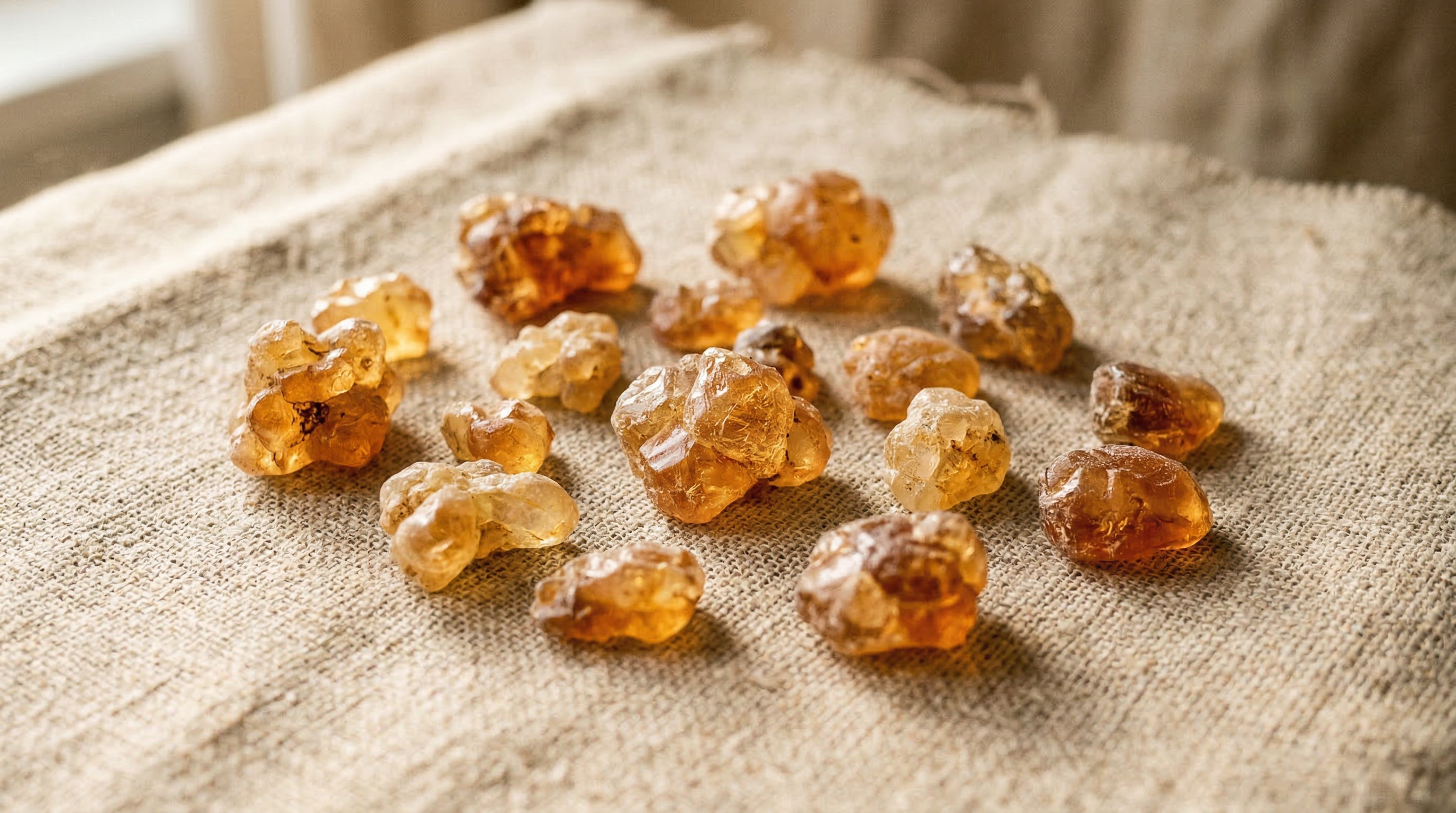
Gum arabic in Mauritania
An ancient site at the crossroads of history, conflict, and rebirth
There are raw materials that rarely get mentioned, yet they’re found in thousands of everyday products. Gum arabic is one of them. It stabilizes sodas, binds confectionery, coats pharmaceutical pills, and sets printing inks, perfumes, and silk. Discreet, natural, indispensable. And in Mauritania, it has a history far longer than the markets that covet it today.
To understand its wide range of uses, from culinary applications to perfumery, we invite you to read our article Gum arabic in cooking, perfumery, and art .
What We've Forgotten
Mauritania was once the world’s second-largest exporter of gum arabic, with an average annual production of 5,700 tons between the 1960s and 1970s. This abundance was no accident. It was based on dense acacia forests, ancestral harvesting techniques, and long-standing integration into the Sahel-Saharan trade routes. As early as the 15th century, European navigators discovered gum arabic on the coasts of Senegal and present-day Mauritania. In the 18th century, a bloody and bitter “gum war” enabled France to secure a monopoly on its trade along the West African coast.
What history had regarded as a resource, geography would eventually undermine. The severe droughts of the 1970s and 1980s, combined with deforestation and rural exodus, have caused production to plummet to about 500 tons per year today. A decline of more than 90% in two generations. This figure does not merely reflect an economic trend. It speaks to the retreat of trees, the desertification encroaching on southern lands, and rural communities that have left production areas for cities that were not ready for them.

The eraser as a living memory
Gum arabic is deeply rooted in the history of Mauritania and the Sahel region. It has been cultivated and used locally for centuries, particularly for its medicinal and culinary properties. Traditionally, it was used to treat respiratory, digestive, and skin conditions. It was also eaten as a treat or incorporated into postpartum remedies to help women regain their strength.
This is not just any ordinary raw material. It is embedded in the collective memory, in the gestures of the gatherers, and in healing practices that predate by far the pharmaceutical companies that use it today. To learn more about its health benefits and contemporary uses, check out our comprehensive guide to gum arabic .
Sudan at War, and What It Means
The civil war that has been raging since April 2023 between the Rapid Support Forces and the Sudanese National Army has had a direct impact on the supply of gum arabic to manufacturers worldwide. Sudan accounts for nearly 80% of global gum arabic production, and recurring political instability has led to export disruptions and price fluctuations over the past decade.
This supply shock has brought to light a reality that industry players had long sought to avoid: such a high degree of dependence on a single country at war constitutes a structural vulnerability. There is now a genuine commitment among manufacturers to diversify their sources of supply. It is against this backdrop that attention is turning to other regions within the Sahel belt, including Mauritania.
New entrants to the industry
The restructuring of the global market does not benefit only large, established producers. It opens up opportunities for countries that had previously been marginalized or overlooked.
Chad is currently the biggest immediate beneficiary. Chad’s exports of gum arabic to the United States reached 2,041 tons in 2024, a 37% increase year-over-year. Mali is also gaining momentum. Mali produces more than 12,000 tons of gum arabic annually, an industry that contributes over 4 billion CFA francs to the national economy. Malian stakeholders are working toward a certification of origin to promote their production on international markets.
Among European processors, investment is on the rise. The global gum arabic market is growing at an annual rate of 7 to 8%, with a projected volume of 60,000 tons by early 2024. It is also worth noting a lesser-known but rapidly expanding use: that of gum arabic in natural winemaking, which we discuss in detail in our article Gum Arabic and Oenology .
Mauritania Confronts Itself
In this context of redistribution, Mauritania has real assets but is slow to mobilize them. Mauritania is part of the gum arabic belt that runs through sub-Saharan Africa. Community organization and the development of plantations are being encouraged to ensure sustainable production while increasing producers’ incomes. The World Bank supports projects aimed at developing gum arabic production in Mauritania, viewing it as a driver of green growth.
But many obstacles remain. The overharvesting of acacia trees is leading to their depletion in certain regions, threatening the sustainability of the resource. The lack of a well-structured value chain limits the sector’s economic potential. Mauritanian collectors often lack access to information about international markets and rarely receive a fair price for their work.
That is precisely where Real and Roots comes into play. We work in direct partnership with local cooperatives in Mauritania, composed mainly of women collectors and small-scale rural producers. This connection on the ground is no mere formality: it determines the quality of the product, the traceability of each batch, and fair compensation for those who harvest by hand, under demanding conditions, a resin that is in high demand on global markets. Choosing our gum arabic means choosing a transparent supply chain, rooted in respect for the communities that sustain it.
Discover our two varieties of gum arabic, carefully selected as part of this initiative: Éclat d'acacia , lightly roasted with caramelized aromas, and Acacia Primordial, pure, untreated gum with revitalizing properties, both available in our Resins collection .

Acacia Trees Against Desertification
What the markets don’t always realize is that Mauritanian gum arabic is not just a commercial issue. It is an environmental issue. Acacia gum producers play a vital role in combating desertification in the arid regions of southern Mauritania. These trees play a crucial ecological role by stabilizing the soil and providing a sustainable source of income.
The olive sector is a major industry because it creates jobs and helps reduce migration to large cities and Europe: it can cut immigration by more than 50%. Behind every kilo produced, there may be a departure averted, a family that stays, and a connection to the land that endures.
What Mauritania Can Do
The window of opportunity is open. It won’t stay that way forever. Countries that can organize their supply chains, certify their production, train their collectors, and negotiate direct partnerships with manufacturers will capture the value that the current chaos is redistributing.
There is a clear trend toward traceable and sustainable sourcing, driven by consumers and manufacturers who want to know where the products they use come from. Mauritania, with its long history, its location within the rubber belt, and its harvesting practices rooted in rural communities, has everything it needs to meet this demand—provided it does not let others get ahead of it once again.
To learn all about the gum arabic we offer, its Mauritanian origins, and its history, we invite you to read our dedicated article: Gum arabic from Mauritania .

The gold of the Sahel has never disappeared. It is simply waiting for the conditions necessary for its revival to be restored.